


KDOT Wichita North Junction
Background
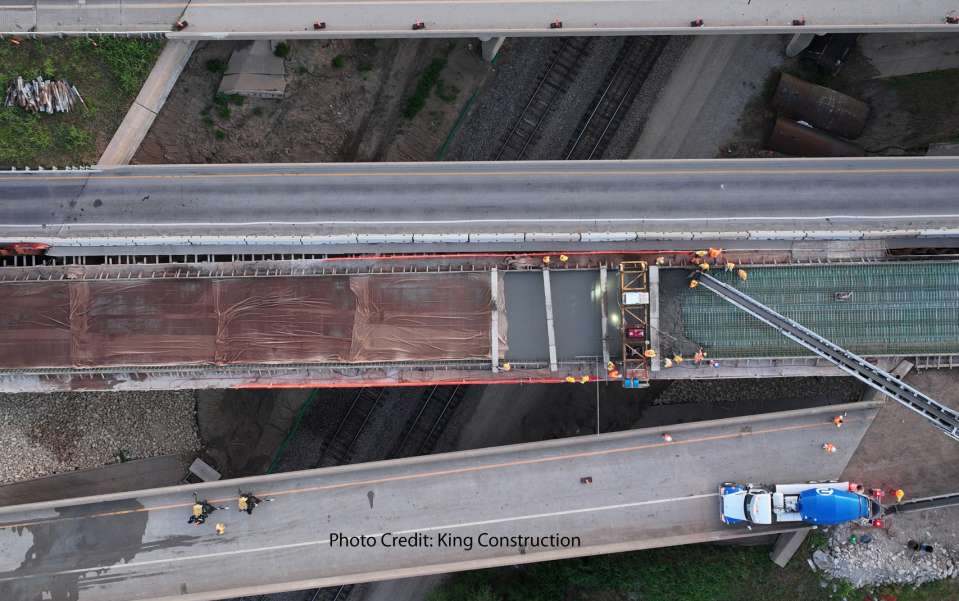
During the latest phase of construction at the highly congested Wichita North Junction, Kansas Department of Transportation (KDOT) aimed to enhance traffic flow and safety through major infrastructure improvements. Because of the significant traffic impacts and the fact that five of the eleven new bridges span rail yards, mainlines and spur tracks, KDOT specified ClearCast® Transparent Bridge Deck Forms to safely speed construction and save time in the schedule. KDOT does not typically allow stay-in-place forms due to the inability to inspect the underside of the deck but made an exception for ClearCast, a transparent stay-in-place form allowing for visibility during and after the deck pour.
Challenges
KDOT initiated this large infrastructure improvement project due to extreme congestion at the Wichita North Junction, where four major highways converge and traffic volumes already exceed 97,000 vehicles per day with projections reaching 160,000 by 2050. KDOT needed to improve safety, reduce crashes, enhance mobility, rehabilitate aging infrastructure, and lower long‑term maintenance costs—all within a tight, high‑traffic work zone. Construction over I‑135 and the Union Pacific Railroad required an accelerated schedule to limit impacts on both rail operations and the traveling public. Traffic volumes of more than 3,500 vehicles per hour created constant safety and traffic‑management pressures. Limited access over the active railroad meant traditional form stripping was not feasible, and KDOT’s typical prohibition on stay‑in‑place forms added another layer of complexity. A solution was required that allowed the forms to remain in place while still enabling full underside inspection of the bridge deck.
CONTRACTOR
OWNER

PRODUCT

ENGINEER

Result
KDOT specified 94,577 square feet of ClearCast® Transparent Bridge Deck Forms, which provided the necessary stay‑in‑place functionality while maintaining full visibility of the underside of the deck during and after construction. Productivity increased by eliminating form stripping, reducing work hours, minimizing lane and track closures, and lowering railroad flagging costs. The transparent system enabled NBIS‑ and element‑level‑compliant inspections for the entire life of the bridge, supporting accurate condition ratings and data‑driven preservation decisions. The new bridges were designed for a 100‑year service life with integrated preservation strategies to reduce corrosion, deterioration, and future maintenance needs. KDOT and PEC expressed strong satisfaction with the outcome, noting reduced downtime for railroad operations, improved construction efficiency, and long‑term inspection advantages unique to ClearCast.